
Sea Shanty Glossary: Words, Terms & Sailor Slang
Characters
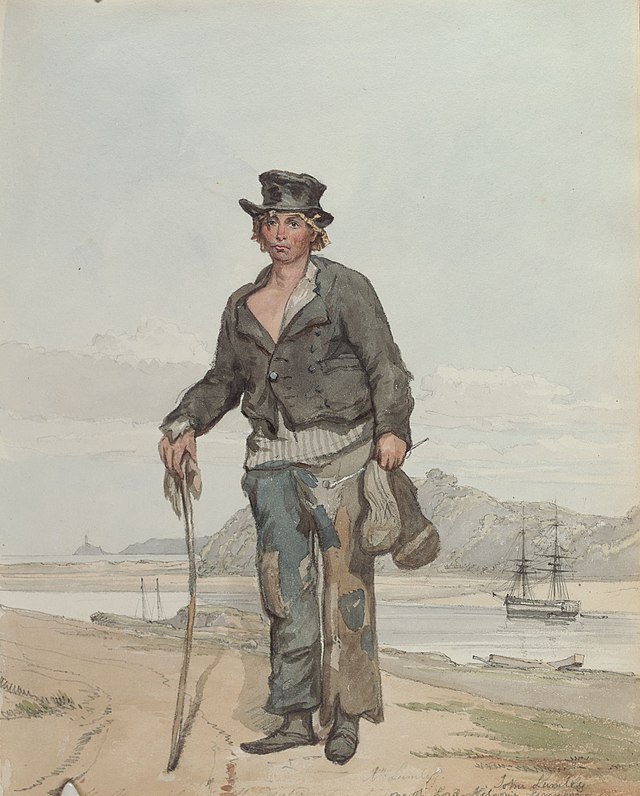
likely called a "Johnny"
Public domain.
- Johnny
- Probably the term most often used in shanties to refer to a sailor.
- Boney
- From Boney was a Warrior — refers to Napoleon Bonaparte. Stan Hugill speculated that it had its origins in the street ballads of the Napoleonic Wars.
- Santy Anna
- "Another mystery is the fascination which Antonio Lopez de Santa Anna (1795–1876) exercised over the sailor. He was one of the many Mexican 'Presidents' and was defeated by the American General Taylor in 1847. That did not prevent the British sailor presenting him in the light of an invariable victor until he was led out to be shot (he really died a natural death) by persons unknown." *
- Ranzo
- "Who Ranzo was must ever remain a mystery. Capt. Whall suggests that the word might be a corruption of Lorenzo, since Yankee Whalers took many Portuguese men from the Azores, where Lorenzo would have been a common enough name. He adds that in his time the shanty was always sung to the regulation words, and that 'when the story was finished there was no attempt at improvization; the text was, I suppose, considered sacred.'" *
- Stormy
- Stormalong John.
- Jack Tar
- Slang for a sailor — it may have come from the tar-impregnated hats and raingear they wore or the ropes they hauled on, which were made waterproof with tar.
Places
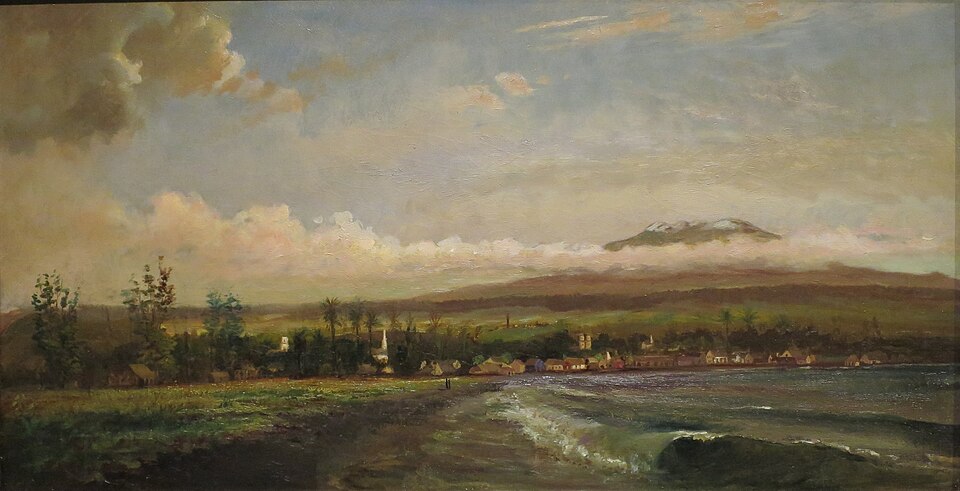
Public domain.
- HiLo
- Stan Hugill says: "…we will now run through those worksongs woven around the word 'Hilo'. Hilo is a port in the Hawaiian group, and, although occasionally shellbacks may have been referring to this locality, usually it was a port in South America of which they were singing — the Peruvian nitrate port of Ilo. But in some of these Hilo shanties it was not a port, either in Hawaii or Peru, to which they were referring. Sometimes the word was a substitute for a 'do', a 'jamboree', or even a 'dance'. And in some cases the word was used as a verb — to 'hilo' somebody or something. In this sense its origin and derivation is a mystery. Take your pick!"
- Mobile Bay
- The bay of Mobile, Alabama, US — this may have worked into shanties from land-based work songs.
- Rio Grande
- "It has been suggested that it refers to the famous river on the Mexican border. It seems clear, however, that it was first sung in the Brazil trade and was inspired by the port and province of Rio Grande do Sul. Most versions show plainly that the Rio Grande of the shanty was not simply a river, but a port or region." — William Doerflinger, Songs of the Sailor and Lumberman
- Shenandoah
- "Shenandoah (English seamen usually pronounced it 'Shannandore') was a celebrated Indian chief after whom an American town is named. A branch of the Potomac river bears the same name." *
Ships and sailing
- Grog
- Named after Vice-Admiral Edward Vernon (and the grogram cloak he wore) — a mixture of water and rum. The rum was an antiseptic and flavour mask for the spoiled water that sailors often had to drink while at sea.
- Windlass
- A barrel-shaped device laid on its side which was used to haul up or 'weigh' the anchor.
- Capstan
- Used like the windlass to haul the anchor, positioned vertically and turned with capstan bars or staves.
- Halyard (Halliard)
- The large thick rope or 'line' used to hoist up sails and the yardarms which hold them.
- Pawl
- The ratchet catch used on the gear of a windlass or capstan to hold the device from moving freely in both directions.
- Tacks
- The ropes or lines attached to the lower corners of sails.
- Belaying Pin
- A thick club-shaped rod made of wood, iron, brass, or steel used to secure the ropes and lines under load.
- Taffrail
- The railing that runs around the stern or rear of the ship.
- Scuppers
- Channels or holes around the deck's edge designed to drain off rain and seawater.
- Blow
- Not a reference to wind — it is a euphemism for being kicked, struck, or knocked down.
- Sheet
- The sails, or more properly, the lines used to control the sails.
- Packet
- Swift ships that ran mail and passengers regularly between America and Europe, mainly Britain.
* from The Shanty Book — Part I, by Richard Runciman Terry, London, 1921