
Types of Sea Shanties
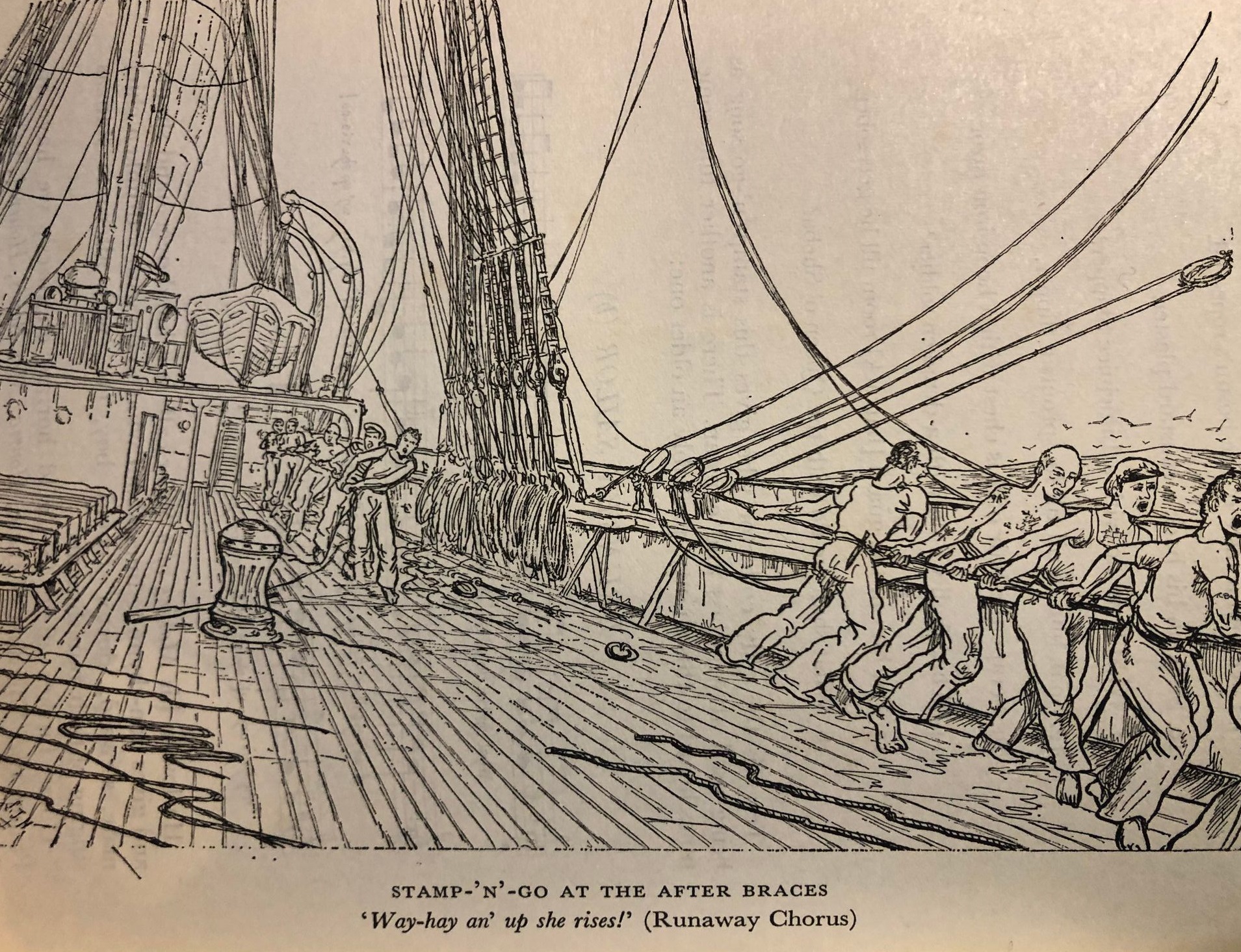
Public domain.
"Shanties may be roughly divided, as regards their use, into two classes: (_a_) Hauling shanties, and (_b_) Windlass and Capstan. The former class accompanied the setting of the sails, and the latter the weighing of the anchor, or 'warping her in' to the wharf, etc. Capstan shanties were also used for pumping ship. A few shanties were 'interchangeable,' i.e. they were used for both halliards and capstan. The subdivisions of each class are interesting, and the nature of the work involving 'walk away,' 'stamp and go,' 'sweating her up,' 'hand over hand,' and other types of shanty would make good reading; but nautical details, however fascinating, must be economized in a musical publication." *
Listen to shanties
Most of these shanty examples are performed by The Longest Johns, a Bristol-based a cappella group widely credited with bringing sea shanties to a new global audience.
Short-haul shanties
Short-haul (or: short drag, double-pull, sweating up) shanty songs were sung when quicker, strenuous work like trimming the sails, raising the masthead, or pumping required quick, hard pulls. The task and the song were shorter in length than other types.
Examples: "Johnny Boker", "Paddy Doyle",
"Haul Away, Joe"
Long-haul shanties
Long-haul (or: long drag, single-pull, halyard) shanty songs were sung during longer jobs such as hauling up the yardarms. The shantyman would sing or line out the verse while the men rested and got a better grip, then they would sing the chorus during the long haul of the rope, or halyard.
Examples: "Tom's Gone to Hilo",
"Blow the Man Down",
"Hanging Johnny"
Windlass & pumping shanties
Windlass shanty songs were sung during the hauling up or "weighing" of the anchor when it was fixed to a horizontally-placed, barrel-shaped tool called the windlass.
Examples: "Shenandoah", "Fire Down Below",
"Oh, You New York Girls (Can't You Dance the Polka)"
Pumping shanty songs were sung during the frequent and strenuous work of pumping water out of the bottom, or bilge, of the ship.
Examples: "Stormalong John", "Lowlands",
"The Dead Horse"
Capstan shanties
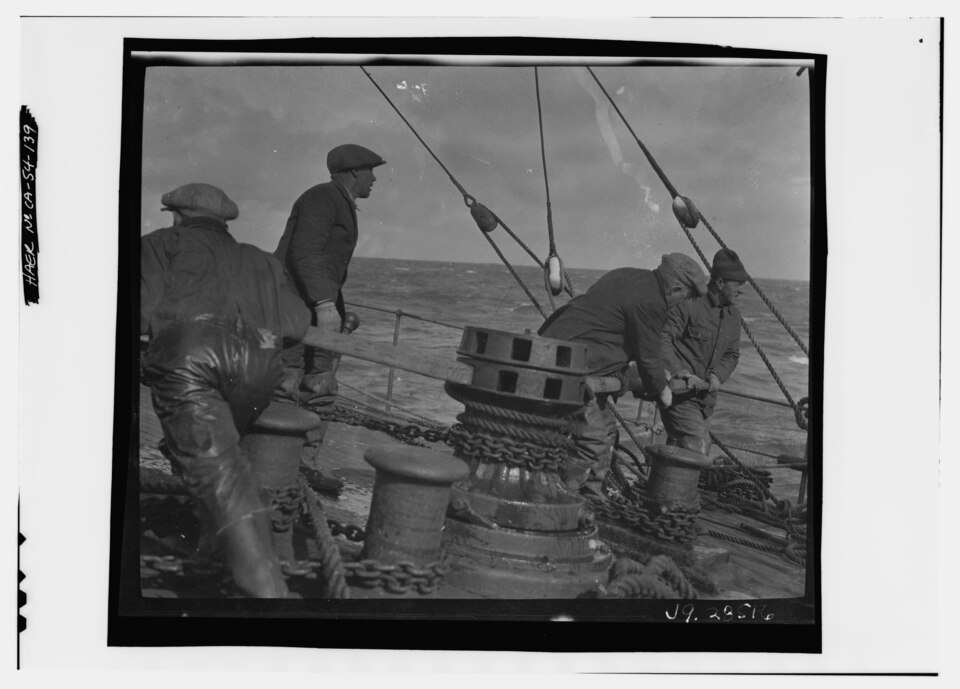
capstan aboard the ship Balclutha, 1925,"
Public domain.
Capstan shanty songs were sung during the hours spent walking around the vertically-oriented, round capstan, raising the anchor. Unlike the sharp, grunt-timed hauling shanties, capstan shanties had to sustain a crew through long, grinding rotations — sometimes an hour or more of steady plodding before the anchor broke free of the bottom. That sustained effort shaped the music: longer verses, fuller choruses, and a rolling, almost hypnotic rhythm that matched the slow turn of the drum. They are considered the most-developed of the shanties, with a smoother feel, steady rhythm, and usually a full chorus that complements the verses. The best capstan shanties had a quality that good marching music has always had — they made hard, monotonous work feel like something worth doing.
Examples: "Billy Boy",
"Rio Grande",
"Paddy, Get Back"
Stamp-and-go shanties
Stamp-n-Go (walkaway / runaway) shanty songs were sung on ships with larger crews while hauling up the large sails. The men would hold the rope as if in a tug-of-war and stamp out the rhythm while marching along the deck.
Examples: "Roll the Old Chariot",
"Drunken Sailor"
Forecastle & ceremonial shanties
Forecastle and Ceremonial shanty songs were sung during the few times of recreation or rest spent in the crew's quarters of the forecastle, and also on special occasions like crossing the equator or entering port.
Examples: "Rolling Down To Old Maui", "High Barbaree",
"Leave her, Johnny"
More about Leave Her, Johnny at Contemplator.com
* from The Shanty Book — Part I, by Richard Runciman Terry, London, 1921